With the attainment of my doctorate, the idea of returning home loomed, but the clouds of politics in Iraq were gloomy with no promise of good. Despite my fear of persecution, I ventured with the decision after weak 'assurances' from colleagues that time proved to be a grave mistake. I set off in a car I bought with my brother Zuhair's money from France, heading to Baghdad via the overland route. In Belgrade, I faced a harsh night, as I failed to find shelter because I did not then understand the 'rules of bribery' prevailing to secure a hotel room. I continued driving while barely holding on, leading to a horrific car accident that nearly cost me my life and confined me to a hospital bed for days.
In those fateful moments, fate had me meet Iraqis who conveyed a grim picture of what was happening in the country—execution campaigns and liquidation of independents and communists. The warning was like a lifeline, and I decided with a heavy heart to return to Britain, leaving my car wreckage in a government garage in Skopje. I returned to London, where I began a new chapter by marrying my dearest friend and devotion, Joyce, who became my constant companion through every journey. It required exhausting trips to Paris to pursue the car insurance claim, especially after its mysterious 'disappearance' from its government storage location, but eventually, after great effort, I recovered the full insurance amount.
Despite the hope that I might settle in Britain, the winds of the job market did not blow as desired, and finding a suitable opportunity became intractable. I had two offers: one from the University of Algiers and the other from the Libyan University of Garyounis. I preferred Algeria, fearing the volatility of Colonel Gaddafi's political treatment of Arab opponents, as he was an unpredictable man whose decisions on forced deportation were subject to the capriciousness of unstable diplomatic relations.
In Algeria, I faced another type of hardship, colliding with the wall of rigid bureaucracy, financial corruption, and scarcity of basic living necessities. In my early days, I stayed as a guest in the apartment of my friend Hisham Saleh Jabr, along with Iraqi colleagues who had fled the tyranny of the dictatorial regime in search of safety and work. Obtaining independent housing was not easy, and even when available, services were a distant luxury. In our building, electricity was cut off throughout the day and only reconnected at night via a 'cable' connecting the building caretaker to the power source. We circumvented this reality by using the 'tea boiler' to heat bathwater at night, so we could have warm water in the morning for a shower before leaving for work.
My wife Joyce joined me, and we shared the harshness of those days, living on simple 'advances' instead of the regular salaries that were not disbursed during our stay. In the midst of those circumstances, I suffered acute food poisoning after eating chicken contaminated with bacteria, which added to the bitterness of the experience. We began the academic year with a routine meeting with the department head, who started his welcome by distributing course assignments. Following academic hierarchy, the department head began by offering teaching topics to the most experienced among us, Professor Bayoumi, giving him priority in choosing the subjects he wished to teach. Bayoumi surprised us with his response: "Doctor, I am ready to clean the tiles!" This provoked my irritation, and I turned to my colleague sitting beside me and said sarcastically: "If the professor is ready to clean the tiles, what are we to do but clean the toilets?"
That moment was a clear embodiment of the fundamental difference between our natures. The Egyptian psyche, in its profound simplicity, views work as an act of 'service' that transcends the ego and dissolves in the collective, without diminishing the worth of the doer. As for us, our inherited culture, laden with historical bitterness, placed 'dignity' in a rigid framework. For us, dignity remained a symbol of survival, and any concession of 'status' or 'mental image' was interpreted as a betrayal of self, and perhaps a breaking of the collective.
But Bayoumi, with his words, gave me an unforgettable lesson. He taught me that true dignity is measured only by the extent of dedication to the higher purpose—and for him, that was remaining in his academic position. I realized that the real challenge today, as we try to build our institutions and nations, is not in clinging to the 'prestige' of professorship that may hinder achievement, but in being great enough to humble ourselves for work, and firm enough to claim our rights through dialogue and construction, not through conflict that only begets fragmentation.
Classes began, but the teaching load was light, and scientific research almost absent in an environment lacking the academic traditions I was accustomed to. The conflicts over the language of instruction in Arabic contributed to exacerbating the situation, hastening my loss of desire to continue. Faced with this situation, I agreed with my friend Qahtan Al-Zubaidi to leave Algeria for Libya, convincing him that the future there would be better. We faced the visa dilemma; while my application was rejected by the Libyan consul, my wife's intelligence and British nationality saved us. I asked the consul whether British citizens were allowed to enter Libya; he answered affirmatively and granted her the visa immediately. Then I surprised him with an ethical and legal question: "How can you allow a British woman to enter alone without her accompanying husband, as you are a Muslim and Arab man?" The consul found no way out of this embarrassment except to grant me a visa as her companion.
Leaving Algeria was not easy either, as it required an 'exit visa' we only obtained after resorting to some dollars, which were and still are the magic key in such countries. At the plane gate heading to Benghazi, Qahtan was prevented from boarding for not having an entry visa, but we succeeded in convincing the captain that he was a university professor contracted with the University of Garyounis, so he agreed on condition that he keep his passport.
We arrived in Benghazi under heavy rain, and did not find the university representative waiting for us due to the flight delay. Qahtan spent his night at the airport to avoid entry, while my wife and I were taken to the hotel, where I felt for the first time in months the meaning of true comfort. I did not rest until the next morning, when I made intensive calls to university officials to secure approval for Qahtan to join us.
My three years in Benghazi were full of giving despite limited university resources. I immersed myself in the worlds of teaching, research, and academic supervision. My efforts culminated in publishing two papers in international journals and another in a local journal. Alongside this professional achievement, I was blessed with the company of a group of loyal friends who formed a warm social circle around us, including Qahtan Al-Zubaidi, Abbas Abu Tabikh, Sabah Manaf, Hussein Nasrallah, and many Iraqi and Libyan friends. Those were beautiful days wrapped in the respect we felt from our Libyan brothers—officials and citizens alike—making that period a station of balance and psychological stability in my journey.
During one of those years, I found myself alone in our apartment in Benghazi during the summer vacation. The university had closed its doors for two months, and I could not travel with my wife, so the apartment became a still place lacking the noise of family and friends. With this oppressive emptiness, I had to find havens to occupy my mind, so I decided to retreat to translating a small book on genetic engineering and protein production, after obtaining the English publisher's approval for an Arabic translation. I completed the task successfully, and the University of Garyounis later published it.
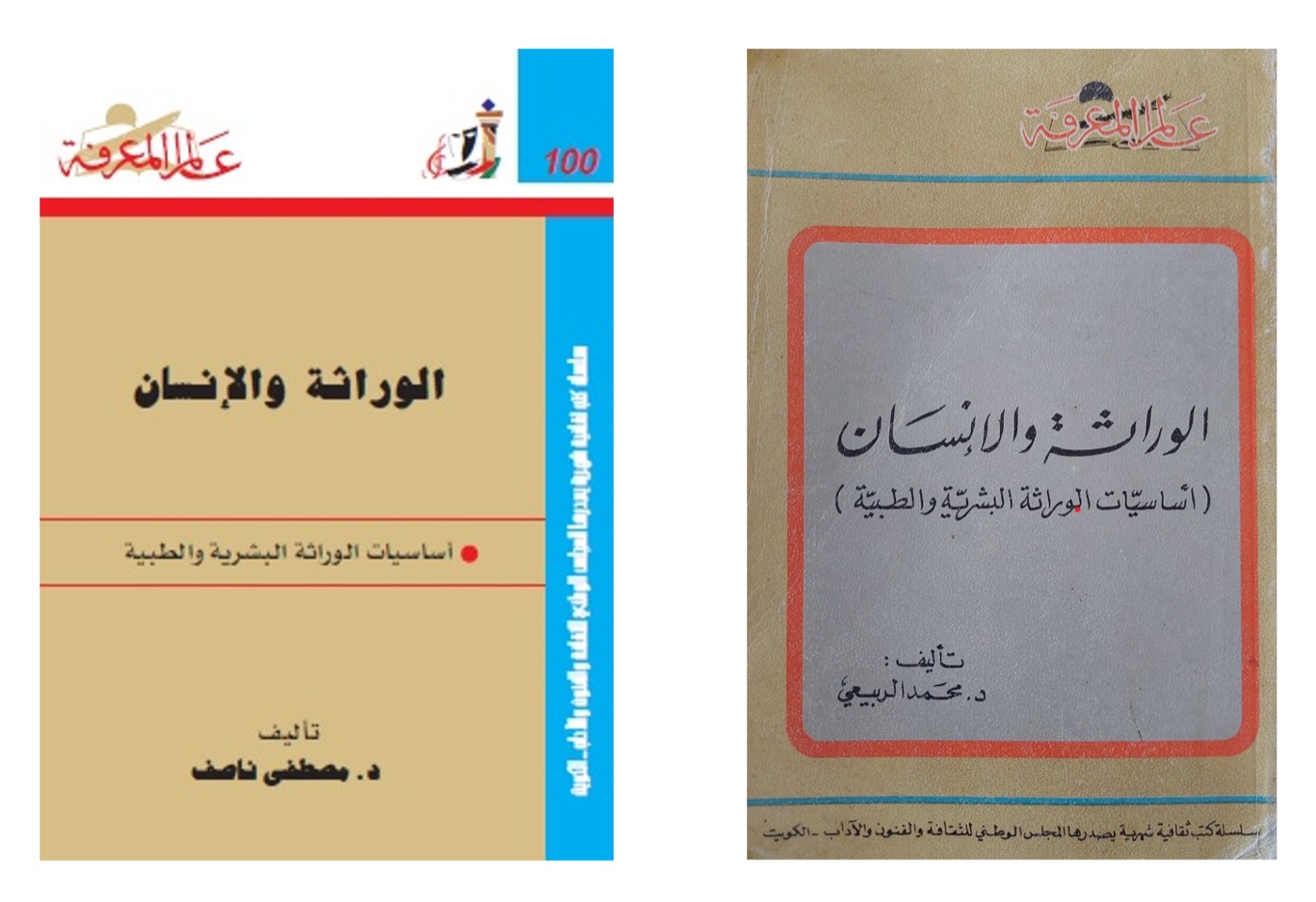
But that isolation was not merely time for translation; it was the spark that ignited within me an urgent desire to write in Arabic. Thus, I began drafting my first book, "Genetics and Man." I was overwhelmed with indescribable joy when the "World of Knowledge" series in Kuwait—published by the National Council for Culture, Arts, and Literature—selected this book for publication. That series was, and still is, one of the most important cultural beacons in the Arab world, and having my book reach Arab library shelves through it was a scientific and literary recognition I greatly cherish.
However, this beautiful memory was not without bitterness. Many years after the book's publication, I was surprised by a new edition bearing the name of another author, "Dr. Mustafa Nassef," instead of mine. Despite my repeated attempts and many calls to the publisher to correct this egregious error, matters remained as they were, and the book is still attributed to someone else on some platforms—a strange paradox between my pride in the work and the bitterness of lost intellectual rights.