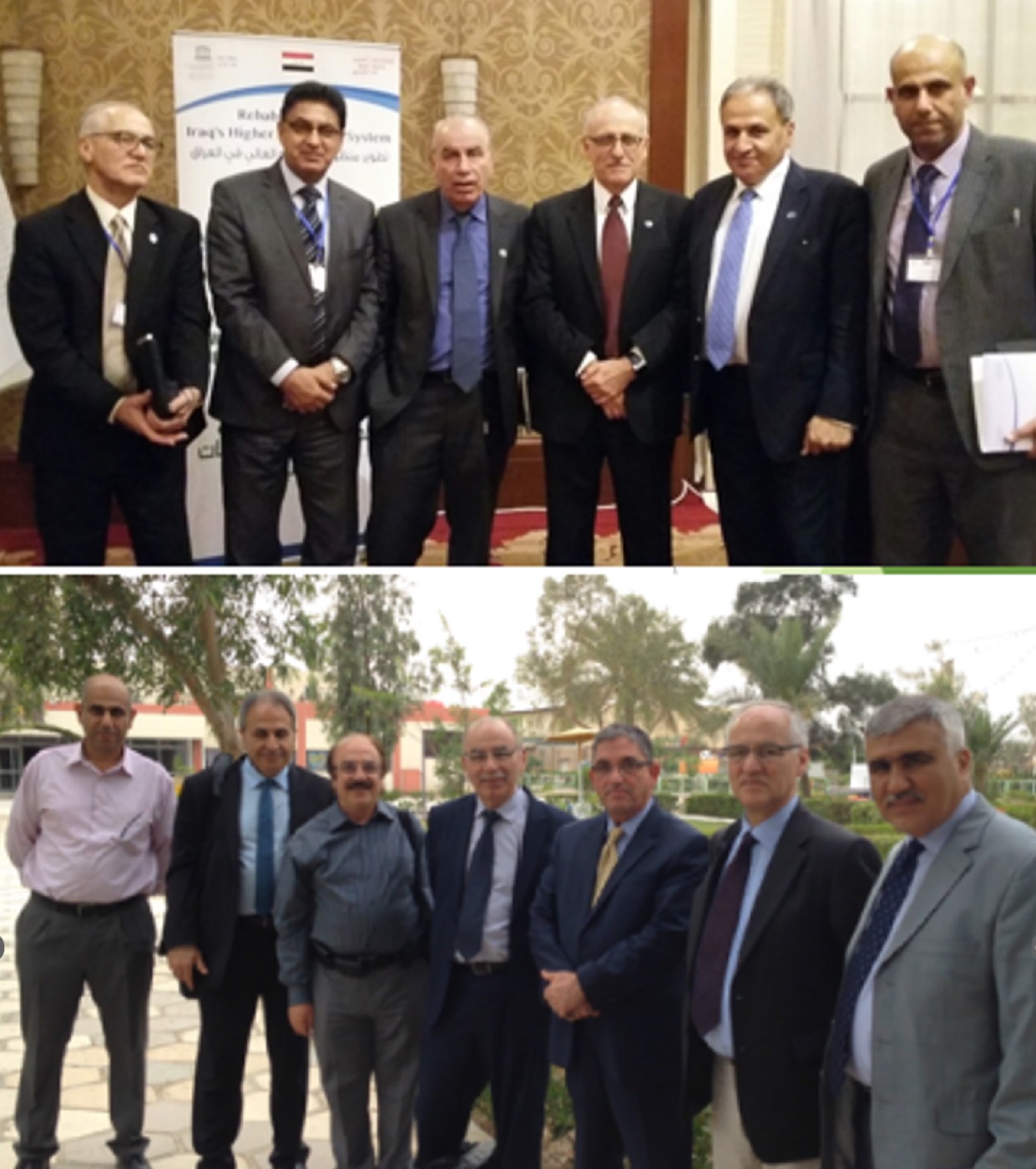
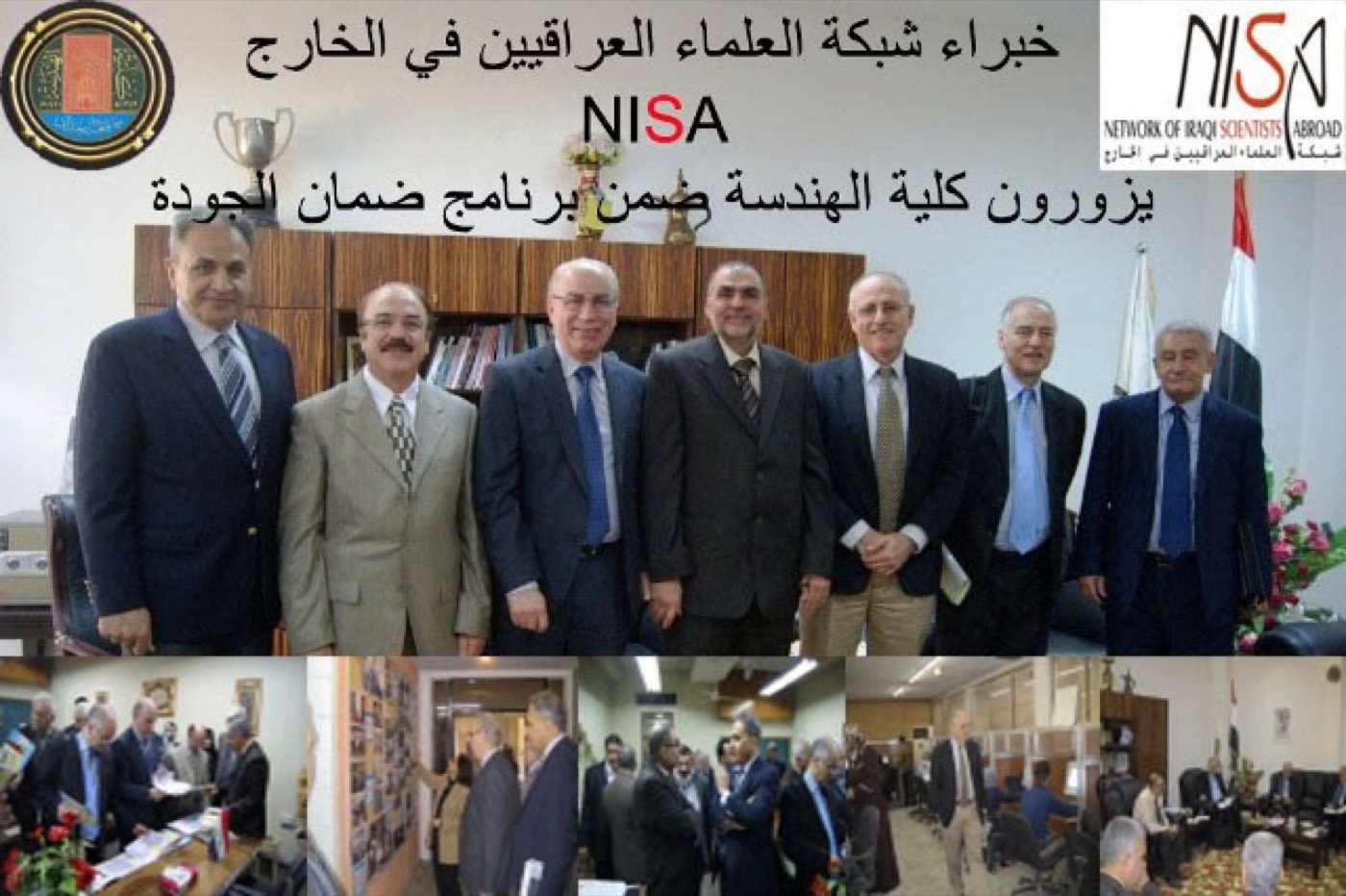
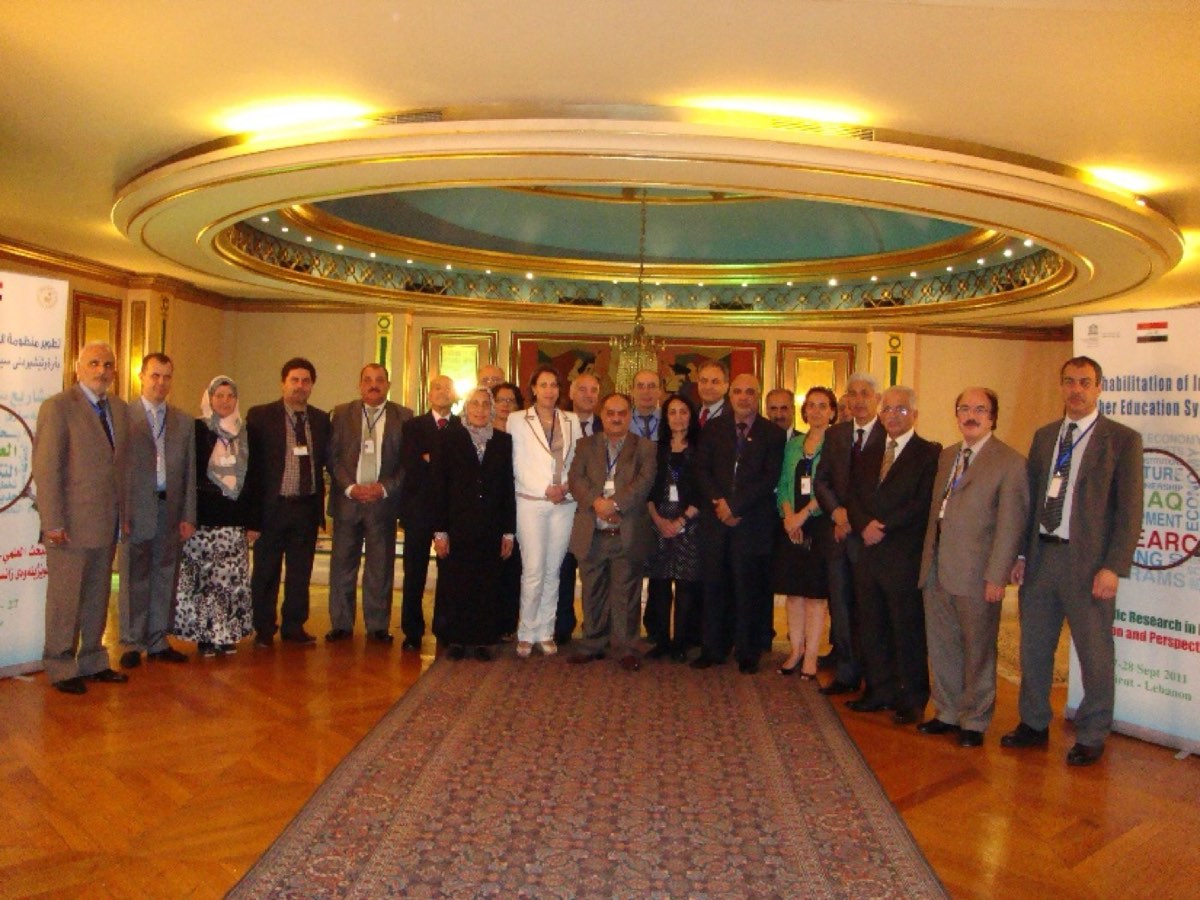
Exile was never an obstacle to the national call, but rather a driver for employing our global expertise in serving future generations in Iraq. From 2008 to 2014, we had the honor of supervising the implementation of the UNESCO strategic project for "Rehabilitating the Iraqi Higher Education System." This project was the embodiment of our national ambition as Iraqi expatriate scientists and experts under the umbrella of the Network (NISA). Our efforts in this project were supported by generous funding from 'Her Highness Sheikha Moza' and supervision by 'UNESCO,' under the capable organizational management of Mrs. Samia Saadawi.
I was honored in this mission to work alongside an elite group of distinguished Iraqi professors at major international universities—my colleagues and partners in this achievement:
- Professor Sabah Jassim (University of Buckingham, UK) — expert in mathematics and computer science
- Professor Ramzi Mahmoud (California State University, Sacramento, USA) — expert in water engineering
- Professor Riyad Al-Mehaidi (Swinburne University of Technology, Australia) — expert in structural engineering
- Professor Muthanna Al-Dahan (Missouri University of Science and Technology, USA) — expert in nuclear engineering
- Professor Bayan Sharif (Newcastle University, UK) — expert in communications. He left our team in the early stages of the project to assume an academic position at a Gulf university.
We were also accompanied in some field visits by Dr. Sadiq Nasrallah, a professor at the University of Technology, who later served as the cultural attaché in Jordan. Dr. Nasrallah combines in his unique academic personality vast knowledge and systematic criticism based on long experience, wrapped in a style of witty humor practiced with rare skill, making him an irreplaceable figure.
Our collective efforts focused on formulating a solid academic future through a series of intensive international workshops hosted by Erbil, Doha, Amman, and Beirut. One of our pivotal roles was qualifying teaching staff in twelve Iraqi engineering colleges, empowering them with 'quality assurance' tools and preparing 'Self-Assessment Reports' (SAR) according to international standards. Our work was not confined to halls or theories but extended to be a living field experience. We conducted detailed visits to the participating colleges to evaluate laboratories and infrastructure, and audit academic documents and curricula. We also held direct and fruitful meetings with administrations, faculty, and students to closely touch the reality of challenges. We concluded this part of our work by presenting a comprehensive roadmap for each college, including essential recommendations for reforming organizational structures and developing academic programs, striving to elevate the quality of educational outputs befitting Iraq's name and scientific history.
What made this academic journey an exceptional experience in my life was not only the weight of scientific responsibility but the high human spirit that prevailed among us as project experts. During those travels, seminars, and intensive workshops, we were not merely professional colleagues; deep friendship bonds were born between us, their seeds growing in training halls and taking root in our sincere brotherly gatherings.
One of the most beautiful features of our team was the spiritual harmony that transcended official titles. We—the expatriate experts—made an implicit decision to break strict academic constraints, addressing each other by first names, far from the titles of 'Doctor' or 'Professor.' This approach, natural for us and derived from our work environments abroad, often aroused surprise and astonishment in Iraqi academic circles that venerate hierarchy and titles.
I remember in one workshop trying to spread this spirit of 'simplicity' when addressing colleagues from inside Iraq. A situation occurred that is still etched in my memory. One professor asked me a question, and I answered directly using his first name, with all warmth. However, it seems the 'title' held a dignity in his mind that I had not appreciated at that moment.
When the tea break came, that colleague approached me, whispering in a tone filled with reproach mixed with resentment: "Dr. Mohamed... I see the word Doctor has become heavy on your tongue... Why? Don't I deserve it?"
That moment was a lesson for me in understanding the gap between two worlds: one that sees titles as a burden hindering communication, and another that sees them as a crowning achievement of a long struggle journey. Despite this, we five (Sabah, Riyad, Ramzi, Muthanna, and I) remained committed to our simplicity, which was the real fuel for the success of our mission.
Among the anecdotes of that period that my memory still holds were those that occurred in one of the workshops on scientific research. While I was objectively reviewing the reality of the decline in scientific research in Iraq, a wave of unjustified "ideological jealousy" erupted. Diaa Al-Mulla (then an advisor at the Ministry of Science and Technology) interrupted me with a crude protest, considering my talk about "scientific backwardness" as an insult that could not be tolerated, proudly declaring himself the first nanoscientist in the world!
The surreality peaked when one of the deans claimed with excessive enthusiasm that his college alone had "two hundred scientists" (perhaps it was two thousand; I don't recall the exact number) who were internationally renowned! Faced with this overwhelming denial, the situation was only resolved by the "whip of logic" wielded by Mrs. Samia Saadawi (the UNESCO project manager), who responded to them with facts about backwardness, and they retreated to their "holes" and forced silence prevailed.
The "coup de grâce" in that comedic scene was delivered by my colleague Dr. Riyad Al-Mehaidi, who—taking advantage of their preoccupation with shouting—quietly searched the laptop for the protesting 'advisor's' scientific record, later announcing the astonishing result: "His distinguished scientific history does not exceed a single paper he published with his supervisor during his studies!"
Among the paradoxes that struck me during the workshops held in Beirut was that evening that unexpectedly combined academic honoring and diplomatic hospitality. The story began with an invitation from the Iraqi ambassador at his home, where a large gathering of various nationalities was assembled in a warm social atmosphere. But the pivotal moment came before the dinner, when the ceremony for awarding the ambassador an honorary doctorate was announced, with the university president present to complete the graduation procedures and present the degree to the student at the heart of that gathering. It was an unusual moment for me—I was accustomed to these ceremonies being conducted with the strictness of university halls and established academic traditions, not moving to private homes. That evening was a living embodiment of the flexibility of customs in our world, where academic platforms could find their way to social gatherings with all the strangeness and surprise that entailed.
What united us—that small group of academics coming from various university cities—was a shared determination to build bridges of communication, a determination that only grew firmer with time. Our cherished memories in Erbil, Amman, Doha, and Beirut remain the sustenance from which we draw strength in our exiles, and the refuge on which we feed in the loneliness of diaspora. To this day, we still eagerly weave plans to gather again, pinning our hopes on Morocco's soil to host our reunion and breathe new life into those bonds that have never been broken.
This group left in my being the most beautiful memories and sweetest times. The product of this human and professional harmony was the most valuable gift we gave to our homeland—we laid together the cornerstone for the 'Quality Assurance and Academic Program Improvement Framework in Iraqi Universities.' Those efforts, undertaken with the spirit of one team and sincere love, have today become the primary reference and current organization for evaluation and assessment processes in our educational institutions.
What gives me the most satisfaction today, when I recall those stations in Erbil, Doha, Amman, and Beirut, is not only the technical reports we produced but the implicit gratitude I sensed in the eyes of participants and their tones of voice. I still remember how their expressions changed from confusion to comprehension, as if we were removing a veil from their eyes regarding concepts of 'quality' and 'self-assessment' that initially seemed to them like dry administrative riddles.
The predominant impression was one of awakening; I sensed in their side conversations genuine appreciation that we did not limit ourselves to theorizing from behind podiums but descended with them into the details of their laboratories and curricula, sharing the concerns of daily reality in their colleges. Many expressed a kind of relief mixed with surprise, as if they had finally found someone who spoke their scientific language and understood their struggles with bureaucracy, providing them with a practical roadmap rather than mere paper promises.
Most participants left those workshops carrying a renewed sense of hope and responsibility. They would confide to me that these meetings restored their confidence in their ability to lift their universities from their current reality, and that they now possessed the 'global' tools enabling them to lead change. This moral impact, manifested in their promises of serious work and those warm handshakes at farewell, is what made me believe day after day that the seeds of reform we planted had found fertile soil in the minds of those academics, and would surely bear fruit no matter how long it took.
We proved that sincere work, when mixed with affection, leaves an indelible mark and lays solid foundations for the future of generations, leaving what we gave as evidence that science and love are the strongest bridges of construction.